Tuesday, May 26, 2015

What Would a Random Power Outage Cost You? You Might Be Surprised


Guest post by Stephanie Gross

What would a random power outage cost you?  Think about all of the important things in your house that require energy to run. Whether it is your hairdryer, television, microwave, or air conditioner, we know you’re dependent on energy for day-to-day tasks and you can’t afford to do without it.


As our reliance on household energy gradually increases, so does the risk of losing power at any given moment. And, on top of that, the U.S. suffers more blackouts than any other developed nation. According to Eaton’s Blackout Tracker Report that was just released, 14.2 million people were affected by power outages throughout 2014. The report includes 3,634 outages that occurred across the country, a 12% increase from that of last year. These are just the reported outages.

The report highlights top significant outages that were unusual and had the most lasting effect.

  • In Georgia a parking attendant gave the keys to an Audi A7 to the wrong customer accidentally and instead of pointing out the mistake the person took the car and crashed into a power pole.
Result: 4,800 residents without power.
  • In Hawaii, a chicken got into some co-op equipment at a switchyard and tripped the circuit breakers.
Result: Half the island without power.
  • In Florida, a fire truck ladder got hooked on power lines and pulled them down causing an outage.
Result: 400 residents without power

2015 is no different. So far, the longest reported blackout was on April 18th in Richmond, Virginia, when squirrels caused a three-day power outage after snacking on some power lines.
The day before that, April 17th in Houston, Texas, 78,000 residents were out of power after a thunderstorm knocked down trees that resulted in major outages. On April 6th, 79,000 lost energy for four hours when an insulator failed in a substation.

These are not rare. Eaton’s blackout tracker shows reported blackouts as they happen. In the past weekend alone, here’s what happened: 
  • 45 people were affected for an hour for unknown reasons in Indianapolis, IN.
  • 3,600 were affected by a garbage truck crashing into a power line in Lauderhill, FL.
  • 2,800 were affected for 2.5 hours by a fire in Marinette, WI.
  • 991 were affected by a fire in Scranton, PA.
  • 1,500 were affected for 9 hours by a fallen wire in Lincoln City, OR.
  • 2,000 were affected for unknown reasons in Kansas City, MO.
  • 12,404 were affected by storms that hit Oklahoma City, OK
  • 1,000 were affected when heavy rainfall cut power in Harrison Country, TX.
  • An unreported number of people were affected 4 hours for planned emergency work in Dallastown, PA.
  • 14,000 were affected when a man crashed into a power pole in Tampa, FL.
Do these places sound familiar to you? Are they near your house? Or maybe you’re one of the 38,340 people who were affected this past weekend by a variety of different causes.
Whether it’s the weather or a freak accident, when a black out hits, it will leave you and your loved ones in the dark. Who knows what you’ll lose. It’s important to be prepared and have a plan for when it does.


Monday, May 4, 2015

Are You Prepared for a Natural Disaster?

Guest post by Jenna Clarke

Living in the Shenandoah Valley of Virginia, the thought of being prepared for a natural disaster rarely crossed my mind three years ago. Although we have snowstorms and occasional flooding, we are not in a tornado alley and have only experienced the most minor earthquakes. Natural disasters can sometimes seem more of an inconvenience than a serious threat.

But last week, while I was visiting a local farmer’s market, I noticed dark clouds gathering across distant hills and I was reminded of a weather event that hit the east coast unexpectedly on a beautiful June day in 2012. On that particular afternoon, I was driving through the rolling hills of Southwest Virginia to visit family and friends at a picnic. It was a bright and calm day – I had the windows down and was taking my time along the windy country roads.

I had barely registered the dark clouds lining the horizon when I noticed the wind picking up and felt a faint chill in the air. I rolled up my windows as the first raindrops fell. Suddenly, the sky turned ink black and the wind blew the trees so hard that they bent sideways. Branches snapped; I heard a loud pop and saw a bright flash as a tree fell 10 yards ahead of me across the road, taking down a power line with it.  I pulled into the closest driveway and spent the next five minutes in terror waiting out what I thought was a freak tornado, but was actually the derecho of 2012.

Photo Attribution: "6-29-2012 Derecho" by NWS/Storm Prediction Center - NWS/Storm Prediction Center. Licensed under Public Domain via Wikimedia Commons - http://commons.wikimedia.org/wiki/File:6-29-2012_Derecho.jpg#/media/File:6-29-2012_Derecho.jpg

 After the storm, millions of Virginians were left without power or running water for almost a week. We lost everything in our refrigerator and hundreds of dollars worth of frozen meat and vegetables. Worst of all, the storm came amidst a heat wave and our vegetable gardens withered and died without water. And similar outages happen every year following ice storms, heavy snows, hurricanes, floods and other forces of nature that are difficult to prepare for because we have not experienced them.

So how to avoid losing so much during an emergency?

Gas generators are an option and certainly one that can fulfill your emergency needs. But how about considering a long-lasting, sustainable solution like a solar powered generator? The SUNRNR is an off-grid solar backup that provides electricity from stored energy in a rechargeable battery so you can use it day or night, in sunshine or in rain. It can run your well pump (SUN240) or appliances (SUN110) during power outages. Even better it can be used safely and cleanly beyond emergencies, to power your cabin, outbuilding, or greenhouse without noise, emissions, or gas storage.


Find out more about the SUNRNR and how to be prepared for natural disasters with back-up solar power here: http://www.sunrnr.com

Sunday, April 19, 2015

SUNRNR Goes to Washington, DC and Beyond: Poised for Export

SUNRNR portable solar generators exportI recently had the great honor of being one of nine small business principals invited by the White House Business Council to attend a briefing with senior Administration officials including Valerie Jarrett, Assistant to the President for Public Engagement and Intergovernmental Affairs, and Jeff Zients, Director of the National Economic Council.  This Small Business Exporters Roundtable was assembled to discuss the President's export and international trade agenda with an emphasis on two potentially-new partnerships, the TPP (Trans-Pacific Partnership) and the TTIP (Transatlantic Trade and Investment Partnership).  Other participants were the Honorable Mayor Bob Buckhorn of Tampa, the Honorable Mayor Michael Nutter of Philadelphia, and the SBA Administrator, Ms Maria Contreras-Sweet.  Oh, and two days before the meeting, we were all told the President would be joining us.
SUNRNR at Small Business Exporters Roundtable


That, he did.  President Obama spent well over an hour asking questions and listening to the nine of us, with products and services in everything from colorants to tea to high-tech equipment to concrete to more concrete to overhead doors to software to renewable energy, tell our individual stories of export to date - problems, successes, paths, results, value.  He also asked the Mayors to comment on how trade affects their cities and the US in general and he had Administrator Contreras-Sweet remind us of the terrific resources available to Small Business, such as loan programs and assistance centers.  Mayor Buckhorn mentioned his city's beautiful ports and how closely foreign trade ties them to jobs and revenue.  Mayor Nutter mentioned the fearfulness many businesses might have toward entering global markets and how important it was to make it easier, less-intimidating, and more secure for them, such as through trade agreements.

They then warned us about "cameras" coming in.  I was naively unprepared as the room more than doubled in attendance with booms, lights, audio, video filling the other side of the room and the President graciously and humorously noted they don't usually hit you on the head.  New experience to say the least.  More available through gettyimages and whitehouse.gov.

SUNRNR and another company were likely tied for "youngest" in terms of exporting, but the President interacted with us all equally.  He saw immediately how our product might be better-suited for certain countries where there is little, none, or an unreliable grid rather than for America, where electricity is plentiful, therefore leaving relatively-niche markets for our product, such as small off-grid, construction, well pumps, preparedness, rural applications.  As to how SUNRNR was fortunate enough to be represented there, it started many years ago with the dream of container-loads of SUNRNR portable solar generators bound for places needing electricity and where just a little would be appreciated and go a long way.

In many cases, such as ours, a small business' "export department" may consist of one or more of the principals.  With no training in this area, I began learning by visiting websites, writing emails, attending seminars/classes/webinars, and scheduling meetings.  The federal and state governments offer so many, almost too many, resources to help.  The US Trade Representative, Virginia Economic Development Partnership, Dept of Commerce, US Commercial News, and Small Business Development Centers were amazingly- and graciously-helpful along the way.  Even a BB&T Bank offered an extremely educational workshop.  It was there that I met a JMU International Business Professor, Dr Marion White, which led to SUNRNR being the focus of a semester-long project for 36 students, resulting in market assessment reports for 12 regions worldwide.  I can not thank the people associated with these resources enough.  Somewhere during those years, several dozen SUNRNRs went to Canada, Africa, and Japan.  The USTR took notice, appreciated our efforts, and extended the invitation to this roundtable.  They also, in a joint project with Commerce, featured SUNRNR as the company chosen to represent Virginia in their United States of Trade booklet published last week.

Less than 1% of the 28 million small businesses in the US have entered into export.  Why should a small business even try?  SUNRNR's vision is to leave a legacy, do something good, see small yellow boxes making and remaking energy everywhere.  These trade partnerships are intended to increase exports by streamlining customs and regulations, reducing barriers such as tariffs, opening new markets, and leveling the playing field.  We experienced the importance of these trade agreements during our sales to Canada, as NAFTA made the transaction easier and less-costly, both for us and for our customers.  We have also learned over time something else mentioned during the roundtable:  Much of the world strongly prefers products marked as "Made in America".  That label connotes quality, craftsmanship, durability, investment.  We welcome business relationship inquiries.

I understand there are controversial issues regarding TPP and TTIP that are well above my pay grade, However, for SUNRNR and other small businesses, increased, simplified export equals increased sales/growth, thus creating jobs, thus strengthening our communities, states, and America as a whole, thereby protecting her global leadership position.  What do trade partnerships mean?  They mean the world to us.

Tuesday, March 24, 2015

Earth Day Reflection: Harnessing the Power of the Sun

What comes to mind when you think of the 1970s? Maybe bell-bottoms, Rock and Roll, Watergate, Vietnam, or Civil Rights? How about the birth of the environmental movement? The first Earth Day was held 45 years ago, on April 22, 1970. It occurred eight years after Rachel Carson’s best-selling Silent Spring raised alarm around the widespread use of pesticides, one year after a massive oil spill covered the shores of California, and nine years before the energy crisis of ’79, which ushered in a recession due to decreased oil output following the Iranian Revolution.

At that time, the environmental movement combined the energy of the anti-war sentiment with the emerging concern around environmental issues, and it was very effective. The first Earth Day garnered support from both sides of the political aisle and led to the passage of the Clean Air, Clean Water, and Endangered Species Acts. In terms of solar energy, the energy crisis of ’79 led to more resources being dedicated to alternative energy and the development of new technologies, bringing the cost of solar cells from $100/watt to $20/watt.

Nearly 50 years later and we have come a long way ($.72/watt!). As the cost of solar panels drops, battery systems improve, and off-grid systems like a SUNRNR solar generator to allow  for flexibility, the concept of alternative energy and solar power has become normal and familiar.

To celebrate this Earth Day, let’s take a step back and think about what it means to actually harvest the awe-inspiringly powerful energy of the sun and how unusual and incredible that is!

The sun lies at the heart of our solar system and makes up 99.8 percent of the solar system’s mass. It is huge – you could fit a million Earths inside the sun! And it is blistering – more than 27 million degrees F at its core. When you step outside and feel the warmth of the sun on your face, it has actually taken that light and heat eight minutes to get to your face because the sun is so far away – 93 million miles away. It is mind-blowing: you are feeling warmth on your face from a giant sphere of hot gas (mostly hydrogen and helium) that is 93 million miles away!

So this Earth Day, whether you’re using your solar generator to power your weekend cabin, riding your bike on a solar sidewalk, or riding in a solar airplane, take a second to remember how incredible solar technology is and how far we have come from the days of Ptolemy when the sun rotated around the earth. And if you have a few minutes, I highly recommend checking out this video from NASA’s Solar Dynamics Observatory. Have you ever seen anything more beautiful than the sun?

And don’t forget SunRnR’s Earth Day Deal! Usher in Spring and Daylight Savings Time by literally saving daylight with a SUNRNR portable solar generator!  From now through Earth Day, use Code DST15 to receive a FREE AC/DC charger ($140 value) with purchase. http://www.sunrnr.com

Blog content by Jenna Clarke

Monday, March 2, 2015

Reducing Your Electric Bill: There's an App for That!

Guest blog by Victoria Olmer

Bills can be expensive, but just about everyone has to pay their bills every single month in exchange for basic needs such as running water and electricity. Electric bills, especially in the winter, can become particularly pricey for those of you with electric heat as you fight to keep out the cold.

Let’s say that you’re trying to switch things up and have decided to reduce your electric bill by 5%. The first thing you’ll want to do is look at last month’s electric bill to see what your monthly electric use was.

Example:
Your last electric bill listed that you used 30 kW (30,000 W) EVERY DAY that month. Take 5% of your electric usage in watts. 5% of 30,000 would be 1,500; therefore, your goal is to reduce your utility electric usage by 1,500 W every day. It’s a do-able goal! And you can think of it as getting 1-1/2 days of electricity FREE every month.

Conveniently, investments such as a SUNRNR ("SunRunner") renewable energy generator can offer 1,500 W each day sustainably (when sun is available for recharge).  This is the offset method - powering that 5% using a source of energy other than the grid.  Of course, another route is pure reduction of consumption and other initiatives, such as turning off the lights or computers when they’re not in use, changing the thermostat by a degree, sealing cracks, washing clothes in warm water instead of hot, etc.

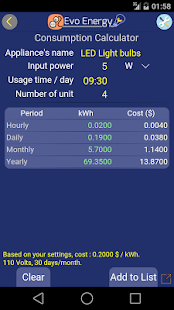
So where do smartphones come in? Well you’ll want to know how to keep track of your electricity usage so you can either cut back or use an alternate energy source. Most of us have smartphones these days and luckily there are a variety of applications that can make this task extremely easy.  Three applications stood out for evaluation. They include Green Outlet, EvoEnergy, and Power Simulator. All of these programs can be downloaded on smart phones either for free or just $1!

For the purpose of reducing your electric bill by 5%, Power Simulator and Green Outlet might be the best applications, since based on your input, they plainly state how much energy a particular appliance uses daily and the associated cost.  They are likely the most-helpful apps for finding that 1,500W and determining which appliances would make the best (and easiest) choice for being run "off grid" or used more efficiently.   


Power Simulator
Pros:
•        Very simple and easy to use! (Although changing cost/kW not very intuitive in Settings)
•        A wide variety of typical appliances and their wattages are pre-programmed.
•        Appliances not in alphabetical order, but are listed by type (kitchen, bedroom, etc.)
•        Total cost and energy usage are given for amount of time the appliance is used per month.
•        Time units can be easily adjusted.
Cons:
•        Not all appliances may be listed.
•        It’s not clear that the cost and wattage predicted is daily.
•        No option to enter your own appliances and wattages.
•        No overall report or option to add up total appliance usage. Only one report for an appliance at a time.


EvoEnergy
Pros:
•        You can create a running list of all appliances for total monthly power usage and cost.
•        Summary provides hourly, daily, monthly, and yearly cost and wattage totals so no math is necessary!
•        Application is relatively easy to maneuver.
•        Allows you to view total and individual monthly costs and wattages.
•        Appliances can be edited and deleted.
•        Power units can be altered (watts, kilowatts, milliamps, amps).
Cons:
•        The “Power Consumption Calculator” on the home page is redundant. Calculations can be done in the “Your List of Appliances” tab.
•        You must enter all data including appliance names and their wattages - ugh!


Green Outlet
Pros:
•        “Welcome” page includes all of the instructions for the entire application.
•        “Settings” provides unique options, such as entering data about your home including size, thermostat temperature, and the number of people.
•        Appliance wattages are pre-programmed, and you CAN adjust the wattage.
•        Includes a carbon footprint reading based on your electricity usage. Very neat!
Cons:
•        Not all appliances may be listed.
•        No option to enter your own appliances and wattages.
•        Instructions are buried in Welcome page, therefore difficult to navigate.
•        “Appliances” page is cumbersome.  Not clear about how to add up total appliance usage.
•         Appliances are not in alphabetical (or even any) order.
•        Must read instructions to understand setting icons for each appliance. 
•        “Estimated Monthly Electric Bill” only updates when you exit an appliance.
•        After all the input, there is no final report, no synopsis of what has been entered.

Editor's Note:
The purpose of evaluating these apps was to find one that would help consumers simulate the benefits of investing in a SUNRNR.  These apps, although educational regarding consumption, did not accomplish the intended mission.  Stay tuned for further options for simulating a SUNRNR as part of your everyday electrical power reduction.


Thursday, February 19, 2015

5 Considerations for Using Solar to Power a Water Pump

Interested in using solar to power a water pump for your home, farm or cabin? Here are 5 things to consider:

In our first blog post of the year we mentioned the incredible potential for using a SUNRNR solar generator to power water pumps, especially in remote locations around the world where access to electrical utilities is costly or impossible. But you can also start right in your own back yard - solar energy is an economic and environmentally friendly option for providing power to pump water for irrigation, livestock, and your home. In fact, according to Colorado State University, solar powered water pumps have been used in the United States for more than 20 years and the number of systems continues to increase as the price of photovoltaic (PV) cells and solar panels drops. The average solar panel now costs around 75% less than it did just five years ago.

Here are a few things to keep in mind as you consider your solar-powered water pump options:
  • Water Storage/Consumption: how much water will you need? The average person uses between 80 – 100 gallons of water per day. Milking cows can require up to 25 gallons of water per day and up to 40 gallons in hot weather. Be sure to factor the requirements for water flow and water storage into your overall system design.
  • Pumps may be powered by standard alternating current (AC) or direct current (DC). DC appliances are typically more efficient than their AC counterparts, using one-third to one-half the energy, but some designs may be powered directly from solar panels, requiring sunshine during use. SUNRNRs store the sunshine for use later and provide either type of current.
  • The SUNRNR system is portable – making it a great option to carry in a pickup truck or mount on a trailer and move with livestock at multiple water sources.
  • A SUN240 HYPERLINK "http://www.sunrnr.com/Products-Pricing.html"“Well Pump” model comes with two 140 W solar panels and stores 2000 W of useable energy. There are many variables to consider including duty cycle and amp draw at pump start, but SUN240s are typically used to power 240VAC well pumps up to 3/4 HP and to a depth of 300'. Check out our detailed well pump fact sheet here and be sure to contact us with your pump’s specifications and your water usage so we can help you determine your daily power requirements and options.
  • Solar generators are also fantastic to use as back up power in your home in the event of an outage – in the words customer Bill G, “ The SUNRNR I purchased from you last year worked like a charm, keeping our freezer cold and running the well pump for water when we needed it.”

Are you using your SUNRNR to power a well pump? Let us know in the comments below. What else will a SUNRNR run? Check out more examples here.


Content contribution by Jenna Clarke

Wednesday, January 14, 2015

New Year’s Resolution: Save Energy (and Money!)


The new year is a great time for starting fresh and creating healthy new habits. But while temperatures  are dropping and rich, hearty meals are calling, maybe it is best to delay that jogging and salad regimen for warmer days, and focus instead on a positive change for both the earth and your wallet - saving energy.

Here are a few ways you can save energy and create a healthier future for yourself, your family, and the environment.

1.     Make an investment in alternative energy. 2015 is the time to invest in alternative energy: the price of solar energy has been steadily and steeply dropping over the last forty years (the cost in dollars per watt is now 100 times less expensive than it was 20 years ago). If you have been considering investing in solar for years, but have been afraid of the up front cost, consider a small, portable system like the SUNRNR portable solar generator. Much less expensive than a full set of solar panels, this versatile system can expand over time as you slowly reduce dependence on the grid. (As a bonus, you will be the envy of the neighborhood when the winter storms hit and you are able to run your appliances using the SUNRNR solar generator).

2.     Drive less. Fuel costs will not drop forever - the best way to reduce dependence on gas and oil is to drive less and focus on increasing healthy transportation alternatives like biking and walking. Another great way to reduce your driving time is to batch all trips that require a car into one outing. It requires a bit of planning, but it sure beats spending a beautiful Saturday criss-crossing all over town in a car. Do you live in a city and need your car to commute? Look for car-sharing options.

3.     Waste less at home. Over time, little reductions in energy use can translate into BIG savings. Zero Waste Home is an excellent resource for ideas on how to save energy throughout the home. Especially helpful is the “store” page with links to gadgets like this $7 faucet attachment that reduces water flow by 77% and this electricity usage monitor  that lets you know how much power appliances are drawing even when they are idle.

Cheers to a great new year! 

Blog contributor Jenna Clarke