Showing posts with label energy consumption. Show all posts

Thursday, September 29, 2016

50 More Ways to Save Energy - Guest Blog Post by Uma Campbell, Writer

50 More Ways to Save Energy
go greenBy now, you’ve probably heard the phrase “going green” being tossed around by family members, friends and politicians, but you may not be sure how you can start living a greener lifestyle. One of the best and easiest ways to go green is to cut back on your home’s energy use, but why should you feel motivated to become more energy efficient?

For starters, being mindful of how much energy you use at home can help you lower your gas, water and electric bills. How? It’s simple: the less energy you use, the less your electric, water or gas company will charge you for their services. Therefore, every energy efficient upgrade or home improvement project you tackle will help put money back in your pocket.

But besides the financial benefits, an energy efficient home can also help the environment. The less energy you use at home, the less of a demand there is for energy sources such as oil, natural gas and coal. The drop in demand prevents these resources from quickly depleting from our planet. When you’re energy efficient at home, you are also doing your part to reduce the carbon emissions released into the atmosphere by power plants, cars, and the handling of waste.


You may think making changes around the home to be more energy efficient is a hassle, but the truth is, you’ll be more comfortable after the improvements are complete. For example, a programmable thermostat that allows you to preset temperatures will help keep your home at a comfortable temperature at all times without wasting energy. It only takes a few minutes to install, but you can enjoy the benefits of it every minute you’re inside your home.

Ready to be more energy efficient but not sure where to start? Luckily, there are dozens of changes you can make—both big and small—to help you cut back on your home’s energy usage. Here are 50 ways you can save energy around your home:


Wednesday, June 22, 2016

SO YOU WANT TO GO SOLAR? FIRST STEP, REDUCE ELECTRICITY USAGE

Step one in going solar is not sizing the Photovoltaic (PV) system, but reducing the energy needed in your home or business. To save green when you go green, first focus on increased sustainability and explore entry-level solar solutions that may provide excellent returns without major expense.  Knowing where your energy needs are highest and implementing shifts in those areas will allow you to more accurately assess the size PV system required and reduce the costs of purchase and installation.  

Focus on These 4 Areas to Increase Sustainability at Home and at Work

 1. Knowledge is power.  Literally.

Reducing energy usage and carbon emissions begins by getting an estimate of your personal carbon footprint or that of your business. The Cool Climate Network offers both a Household Calculator and a Business Calculator.  To receive practical tips to slash your emissions and your energy costs, take this quick and fun CoolerSmarter quiz and you’ll be on your way to 20% less carbon in 20 days.


2. Drive Smart: Transportation is the single biggest contributor to carbon emissions.

If you or your company are in the market for a new vehicle, you can use the calculators and comparison tools at www.FuelEconomy.gov to find the most efficient vehicle for your needs and budget.  Has your knowledge advanced with the technology? Read these Top 10 Misconceptions About Fuel Economy to make sure you are working with the latest information.

Regardless of the car you drive, you can drastically reduce your transportation emissions by simply driving more efficiently.  Slight but significant changes can save you or your business up to 20% at the pumps.


A Solar Solution: Fueling with Sunshine
1 in 3 electric vehicle owners has a home grid-tied PV system. As technologies continue to rapidly develop across the solar industry, running your car on sunshine is increasingly an option.


3. Mind the Gap: Reduce the cost and impact of home heating and cooling.

Heating and cooling are the greatest energy hogs within the home and also represent an area where you can make a significant positive impact, both on your wallet and your carbon footprint.  How do you keep your home comfortable with less energy?

Seal the Leak


Air leaks in your home may waste up to 25% of the heat your heating system generates in the winter and account for the same amount of unwanted heat your home gains in the summer. That’s equivalent to leaving a window in your home wide open all the time. A draft check followed by these simple and inexpensive solutions for energy efficient heating can help you shut that window.

 Natural Home Cooling

Landscaping, blinds, and shade screens are effective at blocking heat from entering your home. And reducing heat generated from within the house can also contribute greatly to lowering the inside temperature.  A significant source of that heat is electric lighting. In just one hour a 100 watt incandescent bulb can raise the temperature of a room by 11 degrees Fahrenheit.  One more reason to switch to cooler, more efficient LED bulbs!
 
“Cool roofs” are another simple strategy to lower electricity costs for your home or business.  Cool roofs reduce the amount of heat conducted to the building below and have several year-round energy-saving and cost-saving advantages over black roofs.


A Solar Solution: Evaporative Coolers

For home and business owners located in dry climates, an evaporative cooler can be a good match for PV. An evaporative cooler, also known as a swamp cooler, will only consume about one-quarter of the power of a traditional central air conditioner.


4. Vampires in the Home: Do you know where your power is going?


Learn just how much energy is being tapped by the appliances and electronics in your home or business by using this Appliance Energy Calculator. Many electronics and appliances are consuming energy, even when not in active use. And by eliminating these phantom loads you can easily and significantly reduce your energy bills.
PC www.energy.gov
  
A Solar Solution: Dedicate one appliance to be powered by the sun.

Can’t go all solar? Dedicate one appliance to run off PV, like your washing machine or well pump.

Water heating is the 2nd largest utility expense in your home. Could a solar water heater be right for you? If so, act soon and take advantage of the federal tax credit that is good until the end of 2016.

Chest refrigerators and chest freezers open from the top and the cold stays put.  Not only is the chest design more energy efficient for all homes, it also offers an incredible opportunity for those interested in entry-level solar.

“Off-grid living doesn’t mean that we go without the energy that we need, but that we live more in tune with the natural rhythms around us.”  By planning wisely and reducing waste in your home or business, you will be well on your way to successfully implementing your solar strategy.


Monday, May 23, 2016

Two Great Resources for Choosing Green Travel Options for You & Your Business


For the Conservation-Conscious Traveler
So you’ve bought the hybrid car, completed an energy audit on your home, invested in some level of renewable energy to power your home, and researched energy-conscious companies to support. What are other choices can you make to live more sustainably?
Making sure you are choosing green and eco-conscious travel options is another way to ramp up your sustainability quotient.  Whether you are making domestic or international travel plans, the growth of a number of green and ecotourism associations can help you locate green lodging, restaurants, resorts and more.
The International Ecotourism Society (TIES) is a non-profit association committed to promoting responsible tourism practices that benefit conservation and communities. With a global network that spans more than 190 countries, TIES is leading the way to make travel and tourism more sustainable. TIES offers a fully searchable database of environmentally-conscious businesses that can help travelers find destinations that fit their conservation and sustainability ideals.
Virginia’s Green Travel Alliance encourages green practices in the state’s tourism industry. ​ More than 1600 tourism businesses and organizations have self-certified their environmental commitments with the Virginia Green program, making it the #1 state-based green tourism program in the United States. 
For Businesses Looking for More Green Choices
Joining organizations like TIES and VGTA not only provide tourism-related businesses with increased visibility, but offer access to cutting-edge conservation and sustainability innovation and training for best practices.  
VGTA and TIES offer a number of business-enhancing opportunities. Some specific programs include:
Industry-Specific Best Practices Resources. Organizations like VGTA and TIES help your business incorporate best practices specific to the tourism industry via workshops, conferences and regular updates on projects, industry events, publications, speaking engagements and networking tools.
Access to data, reports and annual awards can also help businesses measure the benefits of incorporating more green practices and promote that aspect of their company to a wider audience. With hotels alone spending an estimated $7.5 billion on energy per year in 2012, having accurate data on what the introduction of wind turbines, solar panels and/or a myriad of other energy efficient technologies can do to reduce a company’s operating expenses, as well as knowing that such investments can be used as a highly-desirable marketing asset are invaluable resources for many tourism businesses.
Education & Engagement. Educating and engaging the general public towards making environmentally sound consumer choices is also a huge part of the VGTA and TIES missions. Showcasing green products and services at expos around the world like this recent event in Washington, DC is just one way that these type organizations are supporting and promoting green businesses.
The Virginia Green Travel Alliance adds an additional “lead by example” aspect to their educational efforts by recruiting, training and deploying “green team” volunteers at festivals and sporting events around the state to effectively bring recycling, waste reduction, and composting of food wastes to an increasing number of activities each year. This not only makes for greener events, but it emphasizes the importance of choosing green options for travel and entertainment activities.
Act as a Clearinghouse & Green Network. One of the main focuses of Virginia’s Green Travel Alliance is support and promotion of innovative practices and projects through unique partnerships. The Virginia Green Supplier Network is a great example of this business benefit, which provides Virginia Green participants access to a database of green products and services. TIES offers a similar member-only network that promotes information, products and services exchange between members.
Choosing green options for running your business or for vacation planning is easier than ever, thanks to the ongoing growth of organizations like the Virginia Green Travel Alliance and The International Ecotourism Society. Consumers and businesses alike can reap the benefits of better energy and conservation practices through education, promotion and networking via collaborative efforts like these, and know they are doing right by our communities and our planet!


Are you a destination business looking for ways to decrease your energy impact but are not quite ready for a major installation? Contact Sunrunr today for some effective entry-level options for your tourism business. www.sunrnr.com jennyf@sunrnr.com

Friday, January 15, 2016

Best of SunRunner Sphere 2015: More Uses, Better Access and Bigger Savings from Clean Energy Options


With the media and  industry experts touting 2015 as a historically pivotal year in the future of clean energy, we thought we’d take a look back at the most popular posts on the SunRunner Sphere this past year.

Finding new ways to incorporate small, but cumulatively significant renewable energy sources into recurring power requirements around business and home topped the most popular posts of 2015. Five Ways to Incorporate Portable Solar into Your Farm or Garden and 5 Considerations for Using Solar to Power a Water Pump offered lots of information and useful tips about what to consider when choosing alternative energy solutions for important equipment or machinery.

The business of making clean, off-grid, emergency-ready energy options more accessible in domestic and foreign markets also snagged lots of readers in 2015. SUNRNR’s participation in the Small Business Exporters Roundtable in the Spring of 2015.  Jenny French’s discussion of the key elements of legislation and business support required to ensure small businesses like SUNRNR can compete on the larger renewable energy playing field was well received, as was the in-depth look at bringing a new energy product to market in the SUNRNR Celebrates 10 Years series.

And it’s no surprise that articles featuring ways to save money with green products and practices were also big hits with readers. New Year’s Resolution: Save Energy (and Money!) offered suggestions for investing in solar, reducing gas use and tips for less waste at home and What Would a Random Power Outage Cost You? You Might Be Surprised helped readers rethink emergency planning, with an eye towards what an investment in alternative energy emergency options can save over time.

What will the energy picture look like in the coming year? Take a look at some of the predictions for 2016.  

Top Ten Clean Energy Trends Driving the Global Clean Energy Revolution

Monday, March 2, 2015

Reducing Your Electric Bill: There's an App for That!

Guest blog by Victoria Olmer

Bills can be expensive, but just about everyone has to pay their bills every single month in exchange for basic needs such as running water and electricity. Electric bills, especially in the winter, can become particularly pricey for those of you with electric heat as you fight to keep out the cold.

Let’s say that you’re trying to switch things up and have decided to reduce your electric bill by 5%. The first thing you’ll want to do is look at last month’s electric bill to see what your monthly electric use was.

Example:
Your last electric bill listed that you used 30 kW (30,000 W) EVERY DAY that month. Take 5% of your electric usage in watts. 5% of 30,000 would be 1,500; therefore, your goal is to reduce your utility electric usage by 1,500 W every day. It’s a do-able goal! And you can think of it as getting 1-1/2 days of electricity FREE every month.

Conveniently, investments such as a SUNRNR ("SunRunner") renewable energy generator can offer 1,500 W each day sustainably (when sun is available for recharge).  This is the offset method - powering that 5% using a source of energy other than the grid.  Of course, another route is pure reduction of consumption and other initiatives, such as turning off the lights or computers when they’re not in use, changing the thermostat by a degree, sealing cracks, washing clothes in warm water instead of hot, etc.

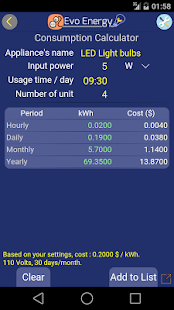
So where do smartphones come in? Well you’ll want to know how to keep track of your electricity usage so you can either cut back or use an alternate energy source. Most of us have smartphones these days and luckily there are a variety of applications that can make this task extremely easy.  Three applications stood out for evaluation. They include Green Outlet, EvoEnergy, and Power Simulator. All of these programs can be downloaded on smart phones either for free or just $1!

For the purpose of reducing your electric bill by 5%, Power Simulator and Green Outlet might be the best applications, since based on your input, they plainly state how much energy a particular appliance uses daily and the associated cost.  They are likely the most-helpful apps for finding that 1,500W and determining which appliances would make the best (and easiest) choice for being run "off grid" or used more efficiently.   


Power Simulator
Pros:
        Very simple and easy to use! (Although changing cost/kW not very intuitive in Settings)
        A wide variety of typical appliances and their wattages are pre-programmed.
        Appliances not in alphabetical order, but are listed by type (kitchen, bedroom, etc.)
        Total cost and energy usage are given for amount of time the appliance is used per month.
        Time units can be easily adjusted.
Cons:
        Not all appliances may be listed.
        It’s not clear that the cost and wattage predicted is daily.
        No option to enter your own appliances and wattages.
        No overall report or option to add up total appliance usage. Only one report for an appliance at a time.


EvoEnergy
Pros:
        You can create a running list of all appliances for total monthly power usage and cost.
        Summary provides hourly, daily, monthly, and yearly cost and wattage totals so no math is necessary!
        Application is relatively easy to maneuver.
        Allows you to view total and individual monthly costs and wattages.
        Appliances can be edited and deleted.
        Power units can be altered (watts, kilowatts, milliamps, amps).
Cons:
        The “Power Consumption Calculator” on the home page is redundant. Calculations can be done in the “Your List of Appliances” tab.
        You must enter all data including appliance names and their wattages - ugh!


Green Outlet
Pros:
        “Welcome” page includes all of the instructions for the entire application.
        “Settings” provides unique options, such as entering data about your home including size, thermostat temperature, and the number of people.
        Appliance wattages are pre-programmed, and you CAN adjust the wattage.
        Includes a carbon footprint reading based on your electricity usage. Very neat!
Cons:
        Not all appliances may be listed.
        No option to enter your own appliances and wattages.
        Instructions are buried in Welcome page, therefore difficult to navigate.
        “Appliances” page is cumbersome.  Not clear about how to add up total appliance usage.
         Appliances are not in alphabetical (or even any) order.
        Must read instructions to understand setting icons for each appliance. 
        “Estimated Monthly Electric Bill” only updates when you exit an appliance.
        After all the input, there is no final report, no synopsis of what has been entered.

Editor's Note:
The purpose of evaluating these apps was to find one that would help consumers simulate the benefits of investing in a SUNRNR.  These apps, although educational regarding consumption, did not accomplish the intended mission.  Stay tuned for further options for simulating a SUNRNR as part of your everyday electrical power reduction.