Tuesday, March 24, 2015

Earth Day Reflection: Harnessing the Power of the Sun

What comes to mind when you think of the 1970s? Maybe bell-bottoms, Rock and Roll, Watergate, Vietnam, or Civil Rights? How about the birth of the environmental movement? The first Earth Day was held 45 years ago, on April 22, 1970. It occurred eight years after Rachel Carson’s best-selling Silent Spring raised alarm around the widespread use of pesticides, one year after a massive oil spill covered the shores of California, and nine years before the energy crisis of ’79, which ushered in a recession due to decreased oil output following the Iranian Revolution.

At that time, the environmental movement combined the energy of the anti-war sentiment with the emerging concern around environmental issues, and it was very effective. The first Earth Day garnered support from both sides of the political aisle and led to the passage of the Clean Air, Clean Water, and Endangered Species Acts. In terms of solar energy, the energy crisis of ’79 led to more resources being dedicated to alternative energy and the development of new technologies, bringing the cost of solar cells from $100/watt to $20/watt.

Nearly 50 years later and we have come a long way ($.72/watt!). As the cost of solar panels drops, battery systems improve, and off-grid systems like a SUNRNR solar generator to allow  for flexibility, the concept of alternative energy and solar power has become normal and familiar.

To celebrate this Earth Day, let’s take a step back and think about what it means to actually harvest the awe-inspiringly powerful energy of the sun and how unusual and incredible that is!

The sun lies at the heart of our solar system and makes up 99.8 percent of the solar system’s mass. It is huge – you could fit a million Earths inside the sun! And it is blistering – more than 27 million degrees F at its core. When you step outside and feel the warmth of the sun on your face, it has actually taken that light and heat eight minutes to get to your face because the sun is so far away – 93 million miles away. It is mind-blowing: you are feeling warmth on your face from a giant sphere of hot gas (mostly hydrogen and helium) that is 93 million miles away!

So this Earth Day, whether you’re using your solar generator to power your weekend cabin, riding your bike on a solar sidewalk, or riding in a solar airplane, take a second to remember how incredible solar technology is and how far we have come from the days of Ptolemy when the sun rotated around the earth. And if you have a few minutes, I highly recommend checking out this video from NASA’s Solar Dynamics Observatory. Have you ever seen anything more beautiful than the sun?

And don’t forget SunRnR’s Earth Day Deal! Usher in Spring and Daylight Savings Time by literally saving daylight with a SUNRNR portable solar generator!  From now through Earth Day, use Code DST15 to receive a FREE AC/DC charger ($140 value) with purchase. http://www.sunrnr.com

Blog content by Jenna Clarke

Monday, March 2, 2015

Reducing Your Electric Bill: There's an App for That!

Guest blog by Victoria Olmer

Bills can be expensive, but just about everyone has to pay their bills every single month in exchange for basic needs such as running water and electricity. Electric bills, especially in the winter, can become particularly pricey for those of you with electric heat as you fight to keep out the cold.

Let’s say that you’re trying to switch things up and have decided to reduce your electric bill by 5%. The first thing you’ll want to do is look at last month’s electric bill to see what your monthly electric use was.

Example:
Your last electric bill listed that you used 30 kW (30,000 W) EVERY DAY that month. Take 5% of your electric usage in watts. 5% of 30,000 would be 1,500; therefore, your goal is to reduce your utility electric usage by 1,500 W every day. It’s a do-able goal! And you can think of it as getting 1-1/2 days of electricity FREE every month.

Conveniently, investments such as a SUNRNR ("SunRunner") renewable energy generator can offer 1,500 W each day sustainably (when sun is available for recharge).  This is the offset method - powering that 5% using a source of energy other than the grid.  Of course, another route is pure reduction of consumption and other initiatives, such as turning off the lights or computers when they’re not in use, changing the thermostat by a degree, sealing cracks, washing clothes in warm water instead of hot, etc.

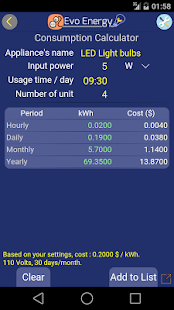
So where do smartphones come in? Well you’ll want to know how to keep track of your electricity usage so you can either cut back or use an alternate energy source. Most of us have smartphones these days and luckily there are a variety of applications that can make this task extremely easy.  Three applications stood out for evaluation. They include Green Outlet, EvoEnergy, and Power Simulator. All of these programs can be downloaded on smart phones either for free or just $1!

For the purpose of reducing your electric bill by 5%, Power Simulator and Green Outlet might be the best applications, since based on your input, they plainly state how much energy a particular appliance uses daily and the associated cost.  They are likely the most-helpful apps for finding that 1,500W and determining which appliances would make the best (and easiest) choice for being run "off grid" or used more efficiently.   


Power Simulator
Pros:
        Very simple and easy to use! (Although changing cost/kW not very intuitive in Settings)
        A wide variety of typical appliances and their wattages are pre-programmed.
        Appliances not in alphabetical order, but are listed by type (kitchen, bedroom, etc.)
        Total cost and energy usage are given for amount of time the appliance is used per month.
        Time units can be easily adjusted.
Cons:
        Not all appliances may be listed.
        It’s not clear that the cost and wattage predicted is daily.
        No option to enter your own appliances and wattages.
        No overall report or option to add up total appliance usage. Only one report for an appliance at a time.


EvoEnergy
Pros:
        You can create a running list of all appliances for total monthly power usage and cost.
        Summary provides hourly, daily, monthly, and yearly cost and wattage totals so no math is necessary!
        Application is relatively easy to maneuver.
        Allows you to view total and individual monthly costs and wattages.
        Appliances can be edited and deleted.
        Power units can be altered (watts, kilowatts, milliamps, amps).
Cons:
        The “Power Consumption Calculator” on the home page is redundant. Calculations can be done in the “Your List of Appliances” tab.
        You must enter all data including appliance names and their wattages - ugh!


Green Outlet
Pros:
        “Welcome” page includes all of the instructions for the entire application.
        “Settings” provides unique options, such as entering data about your home including size, thermostat temperature, and the number of people.
        Appliance wattages are pre-programmed, and you CAN adjust the wattage.
        Includes a carbon footprint reading based on your electricity usage. Very neat!
Cons:
        Not all appliances may be listed.
        No option to enter your own appliances and wattages.
        Instructions are buried in Welcome page, therefore difficult to navigate.
        “Appliances” page is cumbersome.  Not clear about how to add up total appliance usage.
         Appliances are not in alphabetical (or even any) order.
        Must read instructions to understand setting icons for each appliance. 
        “Estimated Monthly Electric Bill” only updates when you exit an appliance.
        After all the input, there is no final report, no synopsis of what has been entered.

Editor's Note:
The purpose of evaluating these apps was to find one that would help consumers simulate the benefits of investing in a SUNRNR.  These apps, although educational regarding consumption, did not accomplish the intended mission.  Stay tuned for further options for simulating a SUNRNR as part of your everyday electrical power reduction.


Thursday, February 19, 2015

5 Considerations for Using Solar to Power a Water Pump

Interested in using solar to power a water pump for your home, farm or cabin? Here are 5 things to consider:

In our first blog post of the year we mentioned the incredible potential for using a SUNRNR solar generator to power water pumps, especially in remote locations around the world where access to electrical utilities is costly or impossible. But you can also start right in your own back yard - solar energy is an economic and environmentally friendly option for providing power to pump water for irrigation, livestock, and your home. In fact, according to Colorado State University, solar powered water pumps have been used in the United States for more than 20 years and the number of systems continues to increase as the price of photovoltaic (PV) cells and solar panels drops. The average solar panel now costs around 75% less than it did just five years ago.

Here are a few things to keep in mind as you consider your solar-powered water pump options:
  • Water Storage/Consumption: how much water will you need? The average person uses between 80 – 100 gallons of water per day. Milking cows can require up to 25 gallons of water per day and up to 40 gallons in hot weather. Be sure to factor the requirements for water flow and water storage into your overall system design.
  • Pumps may be powered by standard alternating current (AC) or direct current (DC). DC appliances are typically more efficient than their AC counterparts, using one-third to one-half the energy, but some designs may be powered directly from solar panels, requiring sunshine during use. SUNRNRs store the sunshine for use later and provide either type of current.
  • The SUNRNR system is portable – making it a great option to carry in a pickup truck or mount on a trailer and move with livestock at multiple water sources.
  • A SUN240 HYPERLINK "http://www.sunrnr.com/Products-Pricing.html"“Well Pump” model comes with two 140 W solar panels and stores 2000 W of useable energy. There are many variables to consider including duty cycle and amp draw at pump start, but SUN240s are typically used to power 240VAC well pumps up to 3/4 HP and to a depth of 300'. Check out our detailed well pump fact sheet here and be sure to contact us with your pump’s specifications and your water usage so we can help you determine your daily power requirements and options.
  • Solar generators are also fantastic to use as back up power in your home in the event of an outage – in the words customer Bill G, “ The SUNRNR I purchased from you last year worked like a charm, keeping our freezer cold and running the well pump for water when we needed it.”

Are you using your SUNRNR to power a well pump? Let us know in the comments below. What else will a SUNRNR run? Check out more examples here.


Content contribution by Jenna Clarke

Wednesday, January 14, 2015

New Year’s Resolution: Save Energy (and Money!)


The new year is a great time for starting fresh and creating healthy new habits. But while temperatures  are dropping and rich, hearty meals are calling, maybe it is best to delay that jogging and salad regimen for warmer days, and focus instead on a positive change for both the earth and your wallet - saving energy.

Here are a few ways you can save energy and create a healthier future for yourself, your family, and the environment.

1.     Make an investment in alternative energy. 2015 is the time to invest in alternative energy: the price of solar energy has been steadily and steeply dropping over the last forty years (the cost in dollars per watt is now 100 times less expensive than it was 20 years ago). If you have been considering investing in solar for years, but have been afraid of the up front cost, consider a small, portable system like the SUNRNR portable solar generator. Much less expensive than a full set of solar panels, this versatile system can expand over time as you slowly reduce dependence on the grid. (As a bonus, you will be the envy of the neighborhood when the winter storms hit and you are able to run your appliances using the SUNRNR solar generator).

2.     Drive less. Fuel costs will not drop forever - the best way to reduce dependence on gas and oil is to drive less and focus on increasing healthy transportation alternatives like biking and walking. Another great way to reduce your driving time is to batch all trips that require a car into one outing. It requires a bit of planning, but it sure beats spending a beautiful Saturday criss-crossing all over town in a car. Do you live in a city and need your car to commute? Look for car-sharing options.

3.     Waste less at home. Over time, little reductions in energy use can translate into BIG savings. Zero Waste Home is an excellent resource for ideas on how to save energy throughout the home. Especially helpful is the “store” page with links to gadgets like this $7 faucet attachment that reduces water flow by 77% and this electricity usage monitor  that lets you know how much power appliances are drawing even when they are idle.

Cheers to a great new year! 

Blog contributor Jenna Clarke

Tuesday, January 6, 2015

SUNRNR Celebrates 10 Years--Part 2 "Introducing a New Energy Product to the Public"

As SUNRNR celebrates its 10-year anniversary providing high-quality, portable solar generators throughout the United States and around the world, we talked to their team about what has kept them in business all these years and their exciting plans for the future. (See Part 1 of the story HERE.)
Scott and Jenny demonstrate a SUNRNR
After nearly five years of research, development, and field-testing, it was time to bring the SUNRNR original portable solar generator to the public. For Phase 2 of the project, Alan would need a team. In 2008, Jenny and Scott French joined SUNRNR. With backgrounds in engineering (Jenny) and business (Scott), the duo began the challenging process of marketing, selling, and distributing a brand-new product from an industry still not well understood by the general public.
What about SUNRNR inspired you to get involved?
Jenny: We believed in the product and trusted Alan – he is a genius in the world of power.
Explain the manufacturing process:
Scott: The learning curve was huge - we were a little naïve in the beginning. Jenny and I spent much time getting a better understanding of the product and all its applications and we participated in assembly while buying and documenting the parts involved. I talk to every customer and/or their dealer and we have had our ears to the ground as to further development of the product according to what customers are looking for.
Why has the SUNRNR been around for 10 years?
Jenny: We have seen other products come and go over the last five years. Many entered, but few are getting past "shake-out" or they are not in the same class as SUNRNR. Our product is an investment - the best of class available and a level above the competition in quality, reliability, design, and system specifications. Scott:  Simply put, the SUNRNR is the best watts per dollar product available.
Jenny:  We also spend a lot of time on customer support - many of our recent sales have been repeat customers adding on to their systems. We’ve never had a customer return a SUNRNR.  We would rather not make a sale than have an unsatisfied or over-expectant customer.
How can SUNRNR act as an “entry level solar system” for homeowners?
Scott: The SUNRNR is a generation/storage/output system for electricity. It gathers solar (or wind) energy and stores it to be used at any time – even at night. Because it is small-scale and transportable, it is a convenient and affordable way to add renewable energy to your home and begin reducing energy costs and reliance on the grid. The versatility and expandability of the system make a SUNRNR an excellent way for homeowners to get started without the expense of a major installation. 
What are some of the unique uses SUNRNR customers have discovered?
Jenny:  The majority use them to offset daily grid usage while awaiting a backup power role, but people use them on farms, in greenhouses, for well pumps, cabins, and on construction sites. We’ve had customers from colleges, music festivals, camps and many, many more. James Madison University Wind Center is currently using a small prototype as an electric bike charging station.
Explain why SUNRNR is called the “Cadillac of portable solar generators”
Scott: I think of it more as the “pickup truck of solar generators.” It’s made for anybody. Yes, high-line in quality and some might say cost, but Audi in construction, Tesla in eco-friendliness, Subaru in durability, Jeep in capability, and Model T in simplicity yet effectiveness.
What has been the best part about being involved with SUNRNR?
Jenny: The people we meet. They are diverse – capable, educated either in life or in school, and sometimes wonderfully wacky. Always interesting.
What is in the future for SUNRNR?
Jenny: Now that SUNRNRs are proven, we are in our next phase - we understand more about the market and will incorporate what we’ve learned. Certain related technologies such as battery storage are changing quickly.  We also feel the product has great potential internationally and are looking to increase sales in countries where residents could benefit from a system like this.  A useful yellow box in every house, garage, pickup truck, or outbuilding!


Interview by Jenna Clarke


Wednesday, December 31, 2014

SUNRNR Celebrates 10 Years--Part 1 "Inventing the First Solar Generator"

SUNRNR Inventor Alan Mattichak putting a unit through the paces.
Ten years ago, on a brisk November morning in the Shenandoah Valley of Virginia, Alan Mattichak awoke from a deep sleep with the idea for an invention that would change the course of his life.

Since he was a toddler, Alan had been interested in electricity. In 2004, he was enjoying a career developing and installing electrical systems and gas-powered generators. The thought of using solar energy had not entered his mind, but on that morning in November, he awoke with the entire plans for a portable solar generator called the “SunRunner” in his head. 

He quickly set to work translating the plans existing in his brain into a durable, quality product. Ten years later, he and two business partners are now selling SUNRNR portable solar generators throughout the United States and around the world. In the process, Alan created a symbiotic relationship with NeuroRestorative Virginia, a nearby rehabilitative center for individuals who have suffered brain injuries.

However, creating a lasting quality product - when only 1 out of 5,000 inventions have successful product launches - takes more than just a brilliant idea. At a time when solar energy companies have come and gone, here is why SUNRNR is thriving 10 years later:

Tell us a little about the invention process. 
Alan: The idea came to me fully formed – it was a gift given to me from God for a higher good. First I ordered the components and made a prototype that worked. Then I fine-tuned the development and completed more field-testing. At that time I saw that this could be a good, useful tool for the world. Within a year I got the trademark – it went right through the first try. Then I got the patent and started building the SUNRNR. All of this took a few years.

Quick fact: Alan kept his Model T in mind during development, ensuring SUNRNR’s were innovative, rugged, powerful, easy to use, and classic.

How is SUNRNR manufactured and how is the community involved?
Alan: I was familiar with NeuroRestorative Virginia and their program [providing rehabilitation services]. On a whim, I asked the director for help with a small project for SUNRNR. Eventually, it turned into a once-a-week vocational workshop where residents help in the sub-assembly of the solar generators which provides cognitive skills-building, mental and physical stimulation, recreation, non-competitive wages, and useful work. When the guys start doing this work, they start getting better. Everyone was stunned with the improvement that was happening in this program. It’s been a blessing and very rewarding to watch.

Quick fact:  75 percent of the SUNRNR’s components are purchased locally and the generator itself is assembled at NeuroRestorative Virginia’s Weyers Cave facility.
   
What do you see next for the SUNRNR?
Alan: SUNRNR has thousands of potential uses. One of my hopes is that they would end up in places around the world where a little electricity goes a long way. Clean water is the single biggest health issue in most of the world. That could change lives and health situations really quickly. The idea for the SUNRNR was a gift given to me for a higher good. There have been lots of blessings in my life but this is a special chapter.

Quick fact:  Many beautiful yellow boxes are currently producing personal power in Canada, Africa, and Japan.


Stay tuned for Part 2 of the SUNRNR Celebrates 10 Years story!  

Interview by Jenna Clarke